


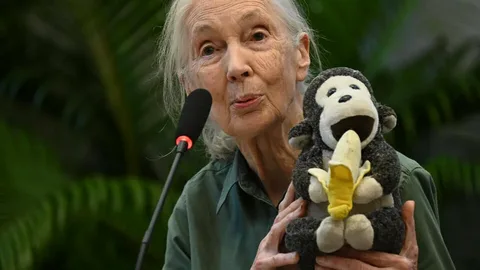
Jane Goodall is one of the most respected and well-known primatologists in the world. Her work with chimpanzees in Africa has changed the way humans understand animals, nature, and even themselves. Born in London on April 3, 1934, Goodall grew up with a love for animals and nature. This passion led her to a lifelong journey of scientific discovery, conservation, and activism.
Goodall’s story is not only about science but also about determination and following one’s dreams. Without a formal college degree in science at first, she dared to go into the African forests to study animals in their natural habitat. This was unusual in the 1960s, especially for a young woman. Her courage and passion soon turned her into a pioneer in the field of primatology.
Her groundbreaking research began in 1960 when she traveled to what is now known as Gombe Stream National Park in Tanzania. She started observing wild chimpanzees closely and patiently, sometimes for hours without moving. At that time, most scientists believed that humans were the only species capable of making and using tools. However, Jane Goodall’s observations proved otherwise.
She noticed a chimpanzee using a twig to pull termites out of a hole. The chimp not only used the stick but also modified it, which meant it was shaping a tool for a specific use. This discovery was revolutionary. It forced scientists to rethink what separated humans from animals. Goodall’s research showed that chimpanzees share many behaviors with humans, including emotions like joy, anger, and sadness, as well as social bonding and complex family structures.
One of the most remarkable aspects of Goodall’s work is her approach. Rather than studying animals from a distance or treating them as simple research subjects, she gave each chimpanzee a name instead of a number. She recognized them as individuals, each with unique personalities and relationships. This human-like view of animals was controversial at the time but later gained wide acceptance and helped shift the scientific perspective.
As the years went by, Goodall became more than just a scientist. She grew into an advocate for conservation and animal welfare. In 1977, she founded the Jane Goodall Institute, an organization that supports wildlife research, habitat protection, and education programs. Through this institute, she has trained and inspired countless young scientists, conservationists, and nature lovers.
One of her most influential initiatives is the Roots & Shoots program, started in 1991. This global youth program encourages young people to take action in their communities to help people, animals, and the environment. It reflects Goodall’s belief that every individual can make a difference, no matter how small their efforts might seem.
Over the decades, Jane Goodall has received numerous awards and honors for her work, including being named a United Nations Messenger of Peace. Despite her international fame, she remains humble and deeply connected to the natural world. She continues to travel around the world, giving talks, meeting young people, and spreading a message of hope.
One of her key messages is the urgent need to protect the planet. She often speaks about climate change, deforestation, and the loss of biodiversity. Yet, unlike many who focus only on the problems, Goodall emphasizes solutions. She talks about the power of education, sustainable living, and the importance of understanding the connections between humans, animals, and the environment.
Her life is a powerful example of how curiosity, patience, and compassion can lead to lasting change. She reminds the world that science is not just about data and discoveries but also about understanding and caring. Her legacy is not only in the books and documentaries about her work but also in the millions of lives she has inspired to care more deeply about the planet.
In conclusion, Jane Goodall is far more than a scientist. She is a role model, a teacher, and a voice for those who cannot speak for themselves—especially the chimpanzees and the forests they call home. Her journey shows what is possible when passion meets purpose, and her work continues to influence how humanity relates to the natural world. Through her life, we are reminded that change often begins with one person who dares to see the world differently.







Comments are closed